Quantum Computing Explained for Beginners
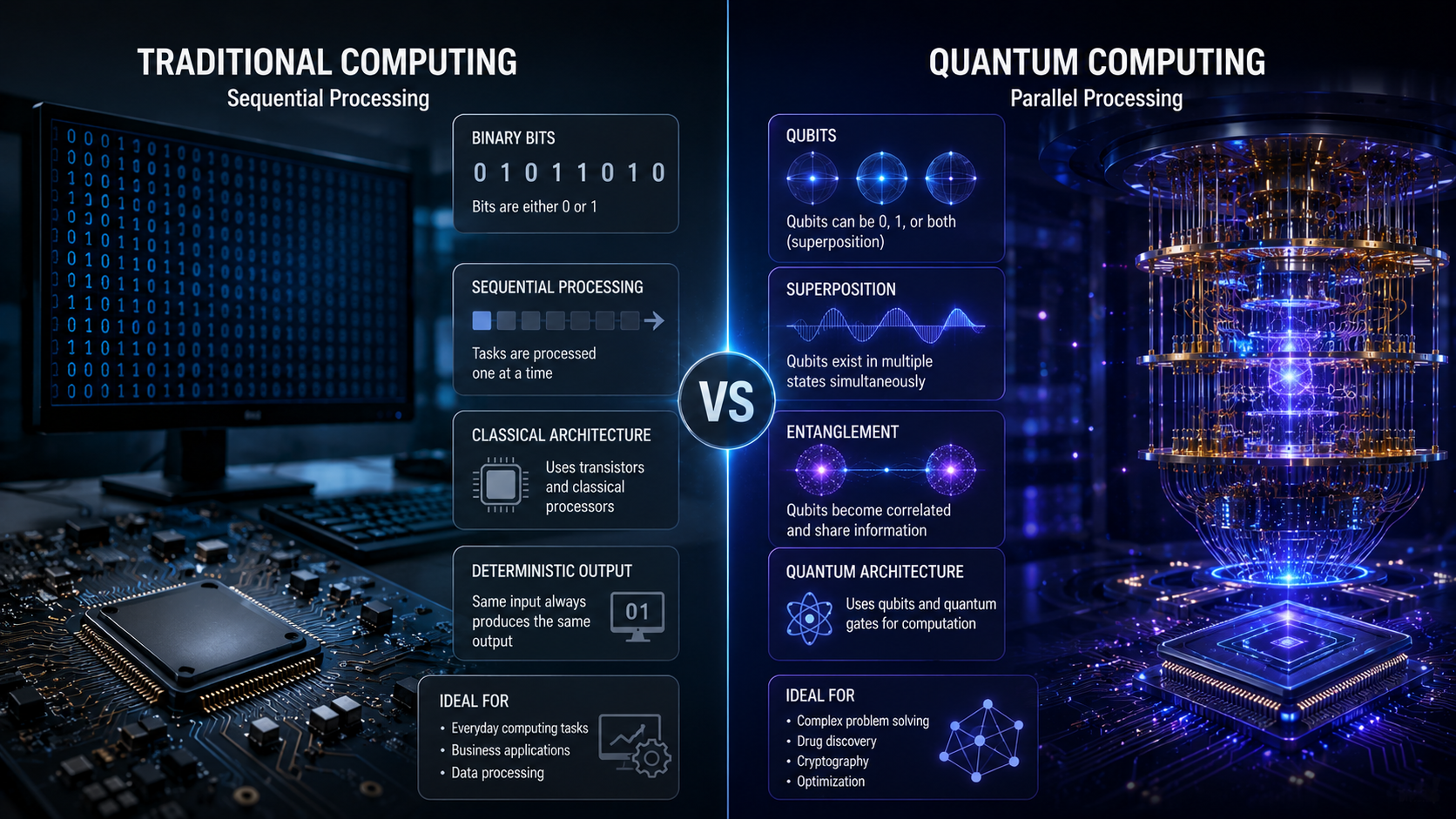
Technology continues to evolve at an incredible pace. While traditional computers have transformed the modern world, scientists are now developing a new type of computing technology that could solve problems far beyond the capabilities of today’s machines. This technology is known as quantum computing.
Many people hear the term but struggle to understand what it actually means. Therefore, this guide provides quantum computing explained for beginners in a simple and easy-to-understand way.
By the end of this article, you will understand how quantum computers work, what makes them different from traditional computers, and why they are considered one of the most important technological breakthroughs of the 21st century.
What Is Quantum Computing?
Quantum computing is a form of computing that uses principles of quantum mechanics to process information.
Traditional computers use bits as the smallest unit of information.
A bit can only be:
- 0
- 1
Quantum computers use quantum bits, also called qubits.
Unlike traditional bits, qubits can exist in multiple states simultaneously.
As a result, quantum computers can perform certain calculations much faster than classical computers.
This concept is the foundation of quantum computing explained for beginners.
Understanding Classical Computers
Before learning about quantum computers, it helps to understand how regular computers work.
Every device you use today relies on bits.
These bits process information through:
- Software
- Applications
- Operating systems
- Internet services
Whether you are watching videos, browsing websites, or sending emails, billions of bits are constantly switching between 0 and 1.
Furthermore, even the most powerful supercomputers still rely on this binary system.
What Is a Qubit?
A qubit is the quantum version of a traditional bit.
However, a qubit behaves very differently.
While a classical bit must be either 0 or 1, a qubit can be:
- 0
- 1
- Both 0 and 1 simultaneously
This property is called superposition.
Consequently, quantum computers can evaluate many possibilities at the same time.
This ability allows them to solve specific types of problems much more efficiently.
What Is Superposition?
Superposition is one of the most important concepts in quantum computing.
Imagine flipping a coin.
When the coin lands, it is either heads or tails.
However, while spinning in the air, it can be thought of as both possibilities simultaneously.
Qubits work in a somewhat similar way.
As a result, quantum computers can explore multiple solutions at once instead of testing them one by one.
Therefore, superposition provides a major performance advantage.
What Is Quantum Entanglement?
Another important concept in quantum computing explained for beginners is entanglement.
Quantum entanglement occurs when two qubits become connected.
Once entangled, changes to one qubit influence the other, even when separated by distance.
Scientists use entanglement to increase computing power and improve problem-solving efficiency.
Furthermore, entanglement allows quantum computers to process information in unique ways that classical computers cannot replicate.
Why Quantum Computers Are Powerful
Quantum computers are not designed to replace smartphones or laptops.
Instead, they are built to solve highly complex problems.
Some examples include:
- Scientific simulations
- Drug discovery
- Financial modeling
- Optimization problems
- Climate research
- Artificial intelligence
Consequently, quantum computers can potentially solve challenges that would take traditional computers thousands of years.
Quantum Computing vs Traditional Computing
Many beginners wonder how quantum computers compare to standard computers.
Traditional Computers
- Use bits
- Process data sequentially
- Excellent for everyday tasks
- Highly reliable
Quantum Computers
- Use qubits
- Leverage superposition
- Utilize entanglement
- Solve specialized problems faster
Therefore, quantum computing complements traditional computing rather than replacing it.
Real-World Applications of Quantum Computing
One reason interest in quantum computing continues to grow is its potential practical applications.
Drug Discovery
Researchers can simulate molecular interactions more accurately.
As a result, new medicines could be developed faster.
Financial Analysis
Financial institutions can optimize investment strategies and risk calculations.
Cybersecurity
Quantum technology may create stronger encryption methods.
However, it could also challenge current encryption systems.
Logistics Optimization
Companies can improve delivery routes, supply chains, and transportation systems.
Artificial Intelligence
Quantum computing may accelerate machine learning and advanced AI research.
Consequently, multiple industries are investing heavily in quantum technology.
Challenges Facing Quantum Computing
Despite its potential, quantum computing still faces significant challenges.
High Costs
Quantum systems require highly specialized equipment.
Error Rates
Qubits are extremely sensitive to environmental interference.
Cooling Requirements
Many quantum computers operate at temperatures close to absolute zero.
Limited Availability
Quantum technology remains largely experimental.
Therefore, widespread adoption may take several more years.
Who Is Developing Quantum Computers?
Several major technology companies are investing in quantum research.
These organizations include:
- IBM
- Microsoft
- Intel
- Amazon
Furthermore, governments and universities worldwide are funding quantum computing projects.
As a result, competition in this field continues to increase.
Will Quantum Computers Replace Regular Computers?
The simple answer is no.
Quantum computers excel at specialized calculations but are not suitable for everyday tasks such as:
- Web browsing
- Word processing
- Social media
- Gaming
Traditional computers will continue to handle most daily computing needs.
Meanwhile, quantum computers will focus on solving advanced scientific and industrial problems.
Therefore, both technologies will likely coexist.
Why Quantum Computing Matters
Understanding quantum computing explained for beginners helps people appreciate the future of technology.
Quantum computers could transform industries by solving problems that are currently impossible or impractical.
Potential benefits include:
- Faster scientific discoveries
- Improved healthcare research
- Better artificial intelligence
- Enhanced logistics systems
- Advanced cybersecurity solutions
Consequently, quantum technology may influence many aspects of society over the coming decades.
The Future of Quantum Computing
Experts believe quantum computing will continue advancing throughout the next decade.
Future developments may include:
- More stable qubits
- Improved error correction
- Greater processing power
- Commercial quantum services
- Broader industry adoption
Furthermore, businesses are beginning to explore how quantum solutions could improve operations and innovation.
Therefore, quantum computing is expected to remain one of the most exciting areas of technological development.
Frequently Asked Questions
What is quantum computing in simple terms?
Quantum computing uses qubits and quantum mechanics to process information in ways that traditional computers cannot.
What is a qubit?
A qubit is the basic unit of information in a quantum computer and can exist in multiple states simultaneously.
Why is quantum computing important?
Quantum computing could solve complex scientific, financial, and technological problems much faster than traditional computers.
Can quantum computers replace regular computers?
No. Quantum computers are designed for specialized tasks, while traditional computers remain better for everyday use.
When will quantum computing become common?
Quantum computing is advancing rapidly, but widespread commercial adoption will likely take several more years.
Explore Quantum Computing with IBM Quantum