How 5G Is Transforming Industries in 2026
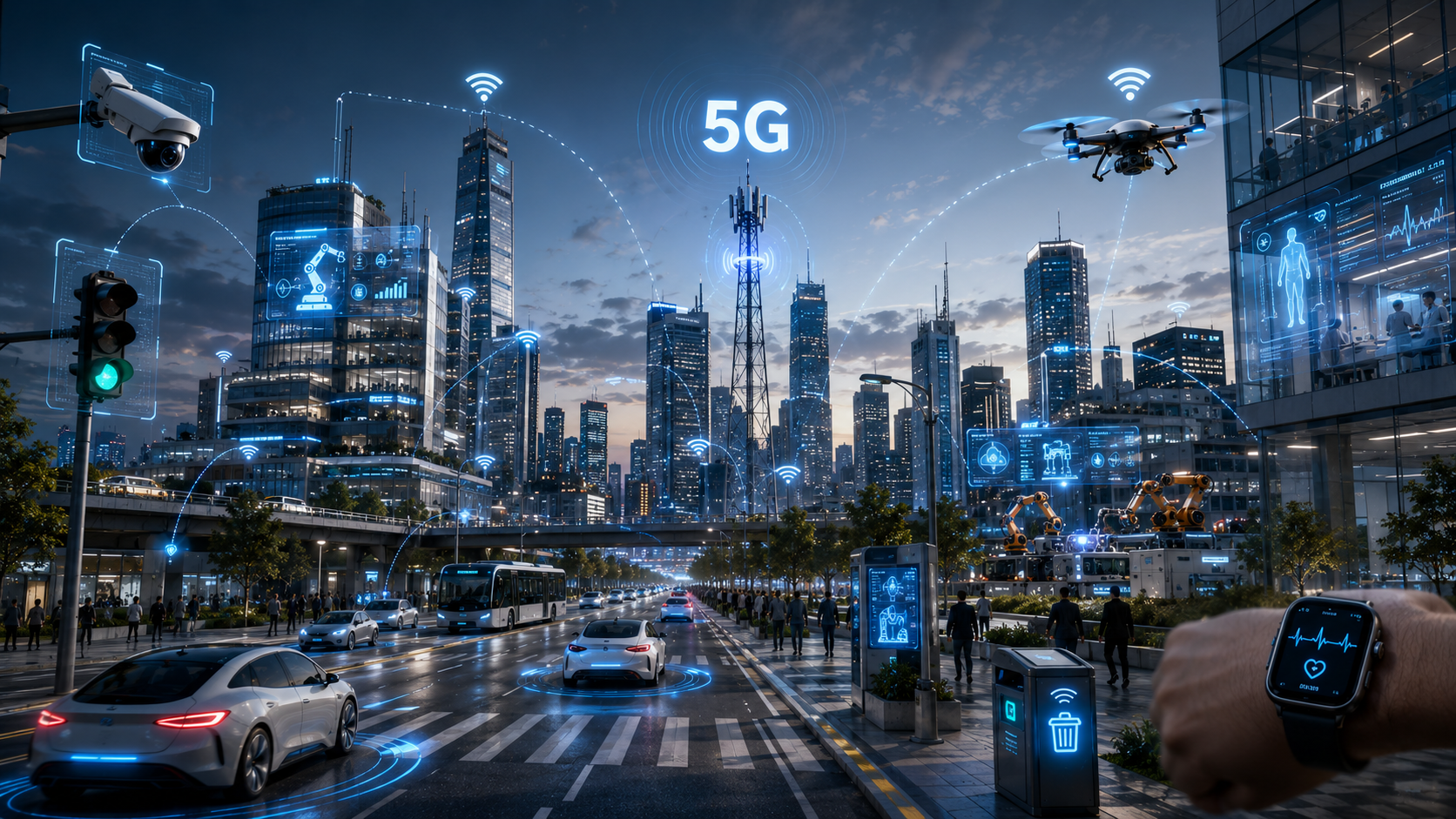
The rollout of 5G technology is reshaping the way businesses operate and how industries deliver products and services. As internet connectivity becomes faster, more reliable, and capable of supporting billions of connected devices, organizations are finding new ways to improve efficiency and innovation.
Understanding how 5G is transforming industries is essential because this next-generation wireless technology is influencing healthcare, manufacturing, transportation, agriculture, retail, and many other sectors. Unlike previous mobile networks, 5G offers significantly faster speeds, lower latency, and greater network capacity.
As a result, businesses can implement advanced technologies that were previously impractical or impossible.
What Is 5G Technology?
5G stands for fifth-generation wireless network technology.
It was developed to improve upon previous mobile communication standards by offering:
- Faster download speeds
- Lower latency
- Higher reliability
- Greater network capacity
- Better support for connected devices
Furthermore, 5G enables real-time communication between devices, which is essential for many modern technologies.
Consequently, industries are rapidly adopting 5G-powered solutions.
Why 5G Matters for Businesses
Traditional networks often struggle when handling large amounts of data and connected devices.
However, 5G addresses these limitations by providing:
- Faster data transmission
- More stable connections
- Improved scalability
- Enhanced automation capabilities
Therefore, businesses can operate more efficiently while delivering better services to customers.
This explains why how 5G is transforming industries has become one of the most discussed technology topics in recent years.
5G and Healthcare
Healthcare is one of the industries experiencing major benefits from 5G technology.
Medical professionals increasingly rely on digital tools for diagnosis, treatment, and patient monitoring.
Remote Patient Monitoring
5G enables healthcare providers to monitor patients in real time through connected medical devices.
As a result, doctors can receive accurate health data without requiring frequent hospital visits.
Telemedicine
Video consultations become smoother and more reliable with low-latency 5G networks.
Consequently, patients can access healthcare services regardless of location.
Advanced Medical Procedures
In the future, 5G may support remote robotic surgeries by reducing communication delays.
Therefore, healthcare accessibility and efficiency continue to improve.
5G in Manufacturing
Manufacturing companies are adopting 5G as part of Industry 4.0 initiatives.
Smart factories depend on connected machines and automated systems.
Industrial Automation
5G allows machines to communicate instantly with one another.
As a result, production processes become faster and more efficient.
Predictive Maintenance
Connected sensors can monitor equipment performance continuously.
Furthermore, businesses can identify maintenance needs before costly failures occur.
Improved Productivity
Real-time analytics help manufacturers optimize workflows and reduce downtime.
Consequently, productivity increases while operational costs decrease.
Transforming Transportation and Logistics
Transportation networks generate enormous amounts of data.
Fortunately, 5G technology can process this information more efficiently.
Connected Vehicles
Modern vehicles increasingly rely on connected systems.
5G enables faster communication between vehicles and transportation infrastructure.
Fleet Management
Logistics companies can track vehicles and shipments in real time.
As a result, delivery routes become more efficient.
Autonomous Vehicles
Self-driving vehicles require ultra-fast communication to operate safely.
Therefore, 5G plays a critical role in future transportation systems.
Smart Cities and 5G
Many governments are investing in smart city projects.
These initiatives use connected technologies to improve urban living.
Smart Traffic Management
5G-connected traffic systems can adjust signals dynamically based on road conditions.
Consequently, congestion can be reduced.
Public Safety
Connected surveillance systems and emergency services can respond more quickly to incidents.
Energy Efficiency
Smart grids can monitor and optimize energy consumption in real time.
Therefore, cities become more sustainable and efficient.
How 5G Is Transforming Industries Through IoT
The Internet of Things (IoT) depends heavily on reliable connectivity.
Because 5G supports a massive number of connected devices, IoT adoption continues to accelerate.
Examples include:
- Smart sensors
- Connected appliances
- Industrial equipment
- Wearable devices
- Smart buildings
Furthermore, organizations gain valuable insights through real-time data collection.
As a result, decision-making becomes more accurate and efficient.
5G and Retail Innovation
Retail businesses are using 5G to improve customer experiences.
Smart Stores
Connected devices help retailers monitor inventory levels automatically.
Personalized Shopping
Real-time data enables businesses to deliver personalized recommendations.
Faster Payments
Enhanced connectivity improves payment processing speeds.
Consequently, customers enjoy a smoother shopping experience.
Agriculture and 5G Technology
Agriculture is another sector benefiting from advanced connectivity.
Farmers increasingly use technology to maximize productivity.
Precision Farming
Connected sensors collect data about:
- Soil conditions
- Weather patterns
- Crop health
- Water usage
Smart Equipment
Autonomous tractors and farming equipment can operate more efficiently.
Therefore, agricultural productivity improves while resource consumption decreases.
Benefits of 5G Across Industries
The impact of how 5G is transforming industries can be seen through several major benefits.
Faster Data Transfer
Organizations can process information more quickly.
Lower Latency
Real-time applications perform more effectively.
Improved Automation
Businesses can automate complex operations.
Better Connectivity
More devices can remain connected simultaneously.
Increased Innovation
Companies can develop new products and services that depend on advanced networking capabilities.
Consequently, 5G is becoming a key driver of digital transformation.
Challenges Facing 5G Adoption
Despite its advantages, 5G implementation still faces obstacles.
Infrastructure Costs
Building 5G networks requires significant investment.
Coverage Limitations
Some regions continue to experience limited 5G availability.
Cybersecurity Concerns
Connected systems create additional security challenges.
Regulatory Requirements
Governments must manage spectrum allocation and network regulations.
Nevertheless, adoption continues to expand globally.
The Future of 5G
Experts predict that 5G will become even more influential over the next decade.
Future developments may include:
- Expanded smart city projects
- More autonomous vehicles
- Advanced industrial automation
- Enhanced virtual reality experiences
- Greater IoT integration
Furthermore, emerging technologies such as artificial intelligence and edge computing will increasingly work alongside 5G networks.
As a result, innovation opportunities will continue to grow.
Frequently Asked Questions
What is 5G technology?
5G is the fifth generation of wireless network technology that provides faster speeds, lower latency, and improved connectivity.
How is 5G transforming industries?
5G improves automation, real-time communication, IoT connectivity, healthcare services, transportation systems, and manufacturing operations.
Why is 5G important for businesses?
Businesses benefit from faster data transfer, better connectivity, improved productivity, and support for advanced technologies.
Can 5G help smart cities?
Yes. 5G supports smart traffic systems, public safety technologies, energy management, and connected infrastructure.
What industries benefit most from 5G?
Healthcare, manufacturing, transportation, retail, agriculture, and smart city development are among the industries benefiting most from 5G technology.
Learn More About 5G Technology